Julie Donec
A Contemporary Portrait and Figurative Canadian Artist
Goldfinch
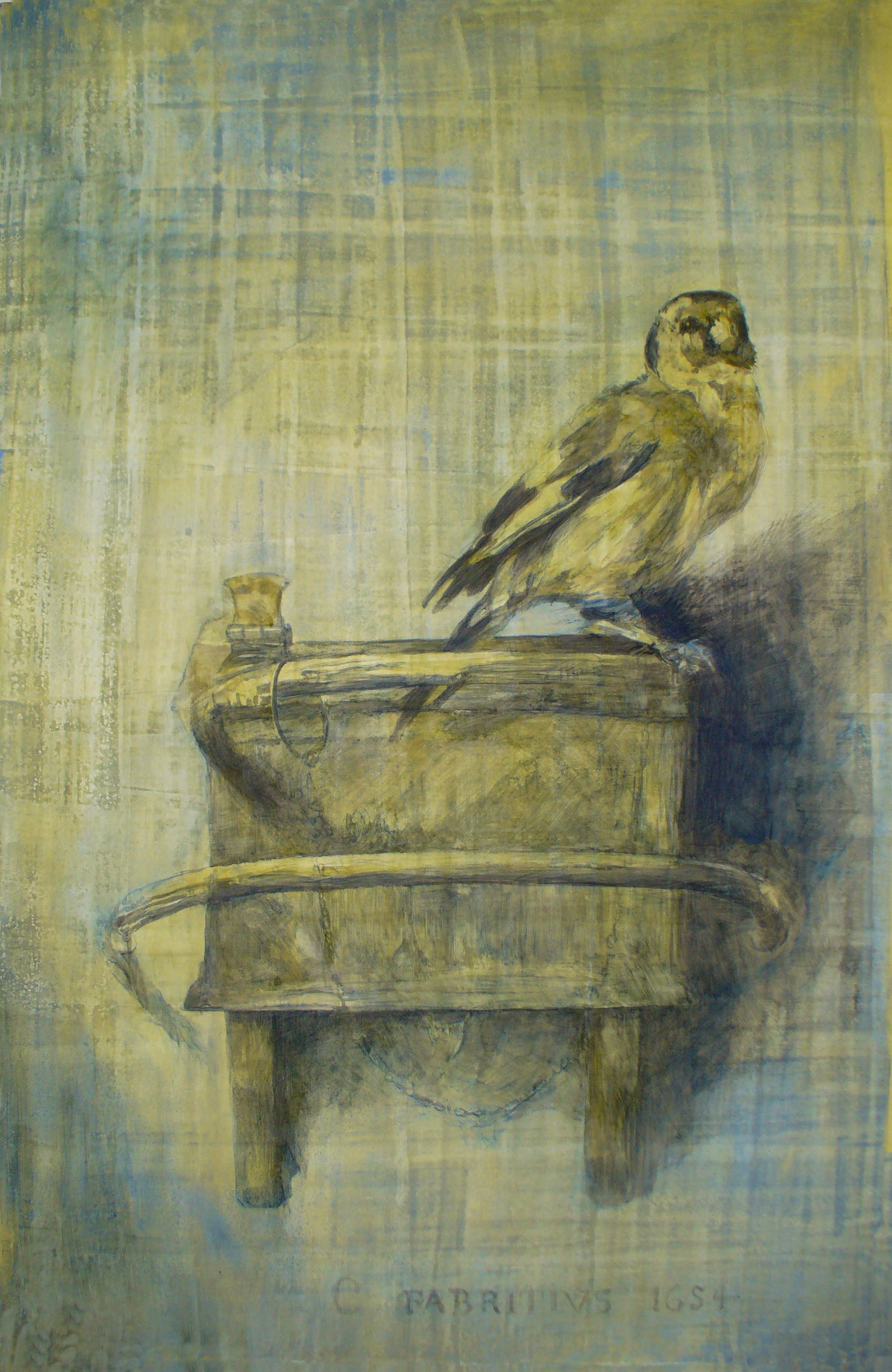
Goldfinch 2
I picked up a postcard of the Goldfinch 1654 when I was at the Mauritshuis Museum in The Hague, and I remember thinking it would make a great study in grays for my students.
When the varnish was removed during the museum’s restoration process, the image appeared much cooler/whiter than the yellowish hue it had before the cleaning. Comparing it with other copies I’ve seen, the original almost seems pale in comparison. The process of copying Master works is a very inexact pursuit; I’ll try to see the original, and get as good a copy as possible to work from, but I can only ‘guesstimate’ on how the image would be done, and what colours I’ll use. The rest is calculated guesswork , a process that will hopefully reveal some interesting technical information like the use dramatic lighting and excellent examples of brushwork.
When I first looked at my colour copy, I saw blue in the background colour, and decided it was a cobalt hue. Fabritius used a mix of lead white mixed with grains of umber or ochre pigment, and surprisingly, large blue splinters of finely ground cobalt glass, or smalt.* I mixed a thin wash of turpentine and cobalt blue onto the panel using the streakiness that happened in the last stage to help build up the wall texture. I try to get the larger mass dark tones established, sometimes rubbing in a larger area with a clean soft cotton cloth. (I’m big on using rags).
Working from dark to light seems more natural to me, and I try to pick out the forms/brushwork as I work in the blues, and then lights.
Following the fat over lean rule, up until now, I’ve only used solvent, in this case Winsor Newton turpentine to lay in any paint. In the next stage, I’ll start using medium. When using medium, try not to use more than 20% medium to 80% paint. I usually use W/N Liquin, especially if I’m trying to get a lot done in a day, as its very quick drying. For this image, I’m trying a new mix of the following:
5 parts turpentine
1 part Damar varnish
1 part stand oil
*Smalt is powdered glass, colored to a deep powder blue hue using cobalt ions derived from cobalt oxide. Smalt is used in glass and ceramics, and decoration. The process used for producing cobalt smalt glass at the Blaafarveværket industrial manufacturing center in Norway in the 19th century has been documented as smelting cobalt oxide together with quartz and potassium carbonate. The result was an intensive blue glass-like substance that was ground and sold to producers of glassware and porcelain.
Picture 7 of 8